

share

Will Your Pension be enough?
Tell us about your pension, savings and lifestyle goals and we'll model your projected retirement income against what you actually want to spend. Our Retirement Readiness Scorecard will tell you where you stand in just 10 minutes. With full Irish Tax built in.
informed decisions blog
Trust in Irish Financial Services: What 49% Actually Tells You
September 21, 2026
Which parts of financial services are trusted least?
Cryptocurrency and digital assets are trusted least globally at 44%. Financial advisory and wealth management sits at 57% and investment management at 55%, while banks score highest of the sub-sectors at 66%.
Before you read any further, answer this honestly: How much do you trust financial services in Ireland? Not one bank, not one adviser, the whole thing. Banks, insurance companies, advisers. On a nine point scale, hand on heart, what number would you give?
Hold onto that number, because a very large piece of global research has just landed with everybody else's answer. And Ireland's answer might surprise you. Or, if you have lived here and paid any attention over the last fifteen years, it might not surprise you at all.
The number, and where it comes from
The 2026 Edelman Trust Barometer is not a financial services firm marking its own homework. Edelman is a communications firm, they have been running this study for 26 years, and this year they surveyed almost 34,000 people across 28 countries. Alongside the main report they publish a separate deep dive on financial services, and that is the one worth reading.
Globally, trust in financial services sits at 63%. That is a reasonably healthy number as these things go, and it has climbed over recent years.
Ireland sits at 49%.
That places us 23rd of the 28 countries measured, really at the bottom of the pile, and in what Edelman classifies as the distrust band rather than the neutral one. The countries below us are Italy, Spain, Germany, Japan and France. The countries at the top are the UAE at 87%, China at 85%, India at 84% and Indonesia at 81%, where eight out of ten people or more say they trust financial services in their own country.
So if the number you gave yourself a moment ago was somewhere around four or five out of nine, you are almost exactly where the Irish respondents landed. And I think that is pretty awful, quite frankly. It is not something I was delighted to read.
The gap that should bother us most
Break the global figure apart and it gets more interesting.
In developing economies, trust in financial services runs at 73%. In developed economies, wealthier countries like our own, it drops to 53%. A 20 point gap, and it went the wrong way this year while the developing number held steady.
Go a layer deeper, into the sub-sectors, and the picture sharpens again:
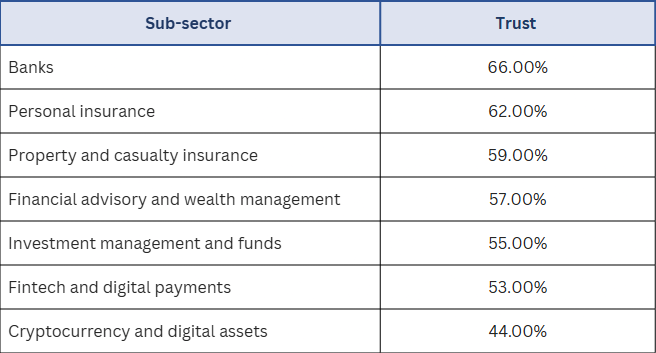
Banks come out best, which may surprise you. Financial advice and wealth management sits a little above half. Say that one in plain English and it is a bit of a kick in the whatever's. Roughly half the people out there trust financial advisers. Roughly half do not, right?!
There is one more cut worth naming: People on higher incomes trust financial services considerably more than people on lower incomes: 68% against 55%, a 13 point gap. Make of that what you will, but it possibly tells you something about how our industry has served, or not served, different groups of people.
And it would certainly explain why an awful lot of people do not engage with this stuff as freely as they otherwise might.
Why Ireland, specifically
The report gives us the number. It does not give us the explanation. So what follows is my own view rather than Edelman's finding.
Part of it is history. We are still, in trust terms, living with the hangover of the banking crisis, the crash and the bailout. That sort of thing does not disappear from the national psyche in the short term.
Part of it is much more recent. The tracker mortgage scandal feels to many people like a thing of the past, and it really is not. Irish banks were shown to have systematically removed or denied the correct lending rate from customers who were entitled to it. The final bill came to roughly €1bn, made up of around €750m in redress and compensation and €278m in fines from the Central Bank. Around 40,000 customer accounts were affected. Bank of Ireland alone was fined €100.5m in September 2022, the largest sanction the Central Bank of Ireland has ever handed down. People lost family homes over it. It was pretty damn shocking.
And in the years since, a series of investment cases has followed a similar shape: seemingly legitimate, customer-focused entities where investors appear to have lost very large sums of savings. Do your own research on those.
Part of it is structural, and this is the part I think matters most. The reality is that for decades, the default and most accessible way to get financial advice in Ireland was through a bank, an insurance company sales force, or an intermediary selling that company's own products. Paid largely by commissions that were not disclosed, or not disclosed meaningfully or clearly.
Compare that to markets where commissions on financial advice were banned outright. The UK banned them years ago, and an adviser there cannot be paid by commission even if they wanted to be. The United States facilitates a clearly commission-free route, and it is very obvious there when something is or is not commission based.
It is interesting that some of the countries furthest along that road, with the clearest separation and the most transparency, tend to cluster among the higher trust developed markets rather than the lowest.
Now, I am not claiming that is why. Correlation is not necessarily causation. But it lines up with what common sense would tell us, if I have not made a bags of explaining it. If people cannot easily see what they are paying, or what the conflicts of interest are, or who their adviser actually represents, trust is not going to flourish.
If you want the detail on what those arrangements actually cost, we have written before about what commission-based financial advice in Ireland really costs you, with the real percentages laid out.
Why is trust in financial services lower in wealthy countries?
Trust in financial services runs at 73% in developing economies against 53% in developed ones, a 20 point gap. Edelman reports the gap but does not explain it; commission disclosure and past scandals are plausible contributors in Ireland's case.
So what would better look like?
Imagine a version of financial advice in Ireland that worked like this.
Advice is fee only. If you want advice, you pay for it, transparently, at a fee agreed in advance for a defined piece of work. No commission-based products are used by firms operating that way at all.
Investment strategies are reliable and, frankly, boring. Decisions about assets, investments and retirement income are made only where they fit a personal financial plan that is tax and estate efficient, rather than the other way round.
This is possibly utopian thinking, and I would point out that when the UK did it, it created an advice gap that was a genuine issue. Solutions have since been built to close some of that. But the model has to be viable at a firm level and valuable at a client level to survive, and I do think there is a way to do it where everybody benefits rather than just the firm, which is quite often the outcome of the more traditional routes.
Informed Decisions is built that way. We receive zero commissions from any product provider or insurance company, full stop. You pay a fee for a service. We do not interact with insurance companies or commission-based schemes. We use transparent, secure platforms and safe custody. Our obligation is entirely to clients. Yes, we need to be a profitable and sustainable business. The duty is to clients first.
In practice that means keeping investments simple when everything out there is telling you to get exotic. It was crypto, then it was ESG, now it is private equity and private credit. These things come and go. Simple, low cost, transparent, liquid, regulated, diversified, with choice and flexibility. No structured products. No hidden layers of charges you need a forensic accountant to untangle.
And it means the opposite of what I once heard described in the insurance world as the mushroom treatment, where you keep people in the dark and feed them rubbish. That expression always struck me. If anything we try to do the complete opposite: an open book approach, and educate to empower. That, to me, is where the real value is.
I am not for a second saying we have this perfect. We are far from perfect and there are things we will keep trying to do better. But by making the effort, individual firms can lift the level of trust in financial services in this country, even if it is only in our own small corner of it.
If you want the wider version of that question, we have also written about how to assess whether financial advice in Ireland is worth trusting, with five things worth checking before you engage anyone.
The uncomfortable part
I will say the obvious thing before somebody else does. Every advisory firm in the country writing about this research will conclude that the answer to a crisis of trust is to hire an adviser. It is a bit convenient.
So let me push back on my own profession instead. Ireland has reason to be sceptical of financial services. We as an industry have earned a good deal of that scepticism. Trust cannot be bought. It takes a very long time to earn and a very short time to break, and we have earned it and broken it in quite a few cycles over the decades.
What I would push back on is the idea that every adviser and every firm deserves to be tarred with the same brush, or that people across the industry are not genuinely trying to make things better for their clients.
One thing I am watching with some concern is the recent wave of private-equity-driven acquisitions and mergers across financial advice and investment management firms in Ireland. It remains to be seen what the outcome of that is for clients and investors. Who knows. Hopefully things will be okay there. I am not certain they will be.
The one thing worth doing
If you take nothing else from this, take this.
At the core of an awful lot of it is money, and specifically who is getting paid what, to do what.
Ask your adviser or your firm how they get paid. How much, and by whom. Ask them who they actually work for.
If the answer is clear, and it takes about a sentence, brilliant. You now know something useful about every recommendation that follows it. If it is not straightforward, or it is not really articulated at all, that possibly tells you something about where your trust should be allocated. That question costs you nothing, and an awful lot of people never ask it.
Ultimately it is a case of judging people by what they have said and done over years, rather than by what they say to you in one meeting.
The Irish number is 49%. It is not a verdict on us and it is not permanent. My hope is that when I am reading this same research in 2030, trust in financial services in this lovely little island of ours is in a much better place than distrust.
I hope this helps.
Paddy
Paddy Delaney QFA RPA APA
Sources: 2026 Edelman Trust Barometer: Insights for the Financial Services Sector.pdf), Edelman Smithfield, April 2026, and the 2026 Edelman Trust Barometer Global Report, January 2026. Tracker mortgage figures from the Central Bank of Ireland. Figures accurate at time of writing and subject to change.
Disclaimer
The content of this site including blogs and podcasts is for information purposes only. Everybody’s financial situation is different and the content we share on our site and through podcasts may not be applicable to you.
The articles, blogs and podcasts are not investment advice. They do not take account of your individual circumstances, including your knowledge and experience and attitude to risk. Informed Decisions can’t be held responsible for the consequences if you pursue a course of action based on the information we share
How much did the Irish tracker mortgage scandal cost?
The tracker mortgage scandal cost roughly €1bn in total, comprising around €750m in redress and compensation and €278m in Central Bank fines, affecting about 40,000 customer accounts. Bank of Ireland's €100.5m fine remains the largest the Central Bank has imposed.
You may also like...
Not sure if your pension will be enough?
Informed Decisions are one of Ireland's only remaining independent financial advice firms. Our free retirement calculator models your income, tax, and lifestyle goals — in 10 minutes.
Find out where you stand today...

.svg)