

share

Will Your Pension be enough?
Tell us about your pension, savings and lifestyle goals and we'll model your projected retirement income against what you actually want to spend. Our Retirement Readiness Scorecard will tell you where you stand in just 10 minutes. With full Irish Tax built in.
informed decisions blog
Prize Bonds Ireland: What the New 1.5% Rate Actually Means
September 14, 2026
What is the new Prize Bond prize fund rate in Ireland?
The prize fund rate rose from 1.00% to 1.50% effective for the September 2026 fund. It sets the size of the monthly prize pool as a percentage of all Prize Bonds in issue, and it had been unchanged at 1.00% since October 2023.
State Savings rates went up this month for the first time in about three years. Every product moved, and the gap between State Savings, Prize Bonds and the banks has just got wider.
That is good news and it deserves saying plainly before anything else. Anyone holding State Savings is better off this month than last.
But the Prize Bond part of that announcement is being widely misread, including in a fair bit of the coverage, and it is worth getting right. The prize fund rate went from 1.00% to 1.50%. That number is not an interest rate. It is not what you will receive. It is the size of the pot the State puts into the monthly draws, expressed as a percentage of every Prize Bond in issue.
There is roughly €4.4 billion of Irish money sitting in Prize Bonds, per the NTMA's own 2025 accounts. An awful lot of us hold some, often since childhood, or have a parent who does. I have a few myself that I was given in 1980 when I was born, and I can tell you exactly what they have paid me since.
Understanding the different Ireland State Savings products
This is where a lot of the confusion starts, so it is worth being clear on what is actually on the shelf. All returns on the fixed-term products and all Prize Bond winnings are tax-free. The Post Office deposit account is the exception and is subject to DIRT.
Savings Bond, 3 years. A lump sum invested for three years, returned with a tax-free gain at maturity. Suitable for genuinely short-term money.
Savings Certificate, 5 years. The same idea over five years, generally at a slightly better annual rate for the longer commitment.
Instalment Savings, 6 years. For regular savers rather than lump sums. You contribute monthly and receive a tax-free return at maturity.
National Solidarity Bond, 10 years. The longest-term product on the shelf, and normally the highest annual equivalent rate.
Post Office Savings Bank account. A demand deposit. Money stays accessible, and unlike everything else here, the interest is subject to DIRT.
Prize Bonds. No interest at all. You hold units and enter monthly and weekly draws. Capital is protected by the State and any prize is tax-free, but the return depends entirely on whether your bonds come out of the draw.
One thing worth knowing about all the fixed-term products: whatever annual equivalent rate applies on the day you enter is the rate you keep for the full term. If rates rise afterwards, you do not move up with them. If they fall, you are protected. That is the deal either way.
What changed, exactly
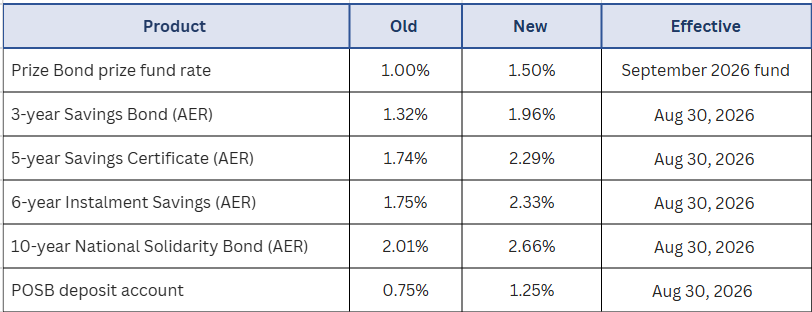
Existing holders of fixed-term products keep the rate they signed up to. The new rates apply to new purchases.
What a Prize Bond actually is
A Prize Bond is a unit of €6.25. The minimum purchase is €25, so four units. The maximum holding per person is €250,000. There is no term and no maturity, and you can cash in any time after 90 days. On flexibility, fair play, it is a good product.
What you do not get is interest. The entire fund shares a prize pool, and the prize fund rate sets the size of that pool. It comes out as a €500,000 jackpot in the last draw of each month, a €50,000 top prize in the other weekly draws, 20 prizes of €1,000 and 20 of €500 every week, and then several thousand prizes of €75. The €75 one is the prize you actually hear about. "I got 75 quid in the Prize Bonds."
Every one of those prizes is exempt from DIRT, income tax, Capital Gains Tax and PRSI. That exemption is one of only two things Prize Bonds genuinely have going for them, and we will come back to both.
The 1.5% is not a return
Here is the part that gets missed almost universally, and it is the reason the rise from 1.00% to 1.50% has been reported as though every holder just got a pay rise.
The prize fund rate describes what goes into the pool. It says nothing about what comes out to you.
Spread across €4.4 billion, 1.5% is an average. Averages are a poor description of lottery-shaped outcomes. A handful of people receive €500,000. The great majority receive nothing at all in a given year. Speaking personally, my own few bonds have returned exactly nothing across forty-six years, if my mathematics is right.
It also does not compound the way a savings rate does. A Savings Certificate rolls up automatically. A Prize Bond only grows if you win and you have opted to have prizes automatically reinvested in new bonds rather than paid to your account. No win, no growth, no matter how long you hold.
So any comparison that puts 1.5% beside 2.66% as though they were two versions of the same thing is comparing a guaranteed rate with the average of a raffle. They are not the same kind of number, and this article is not going to treat them as if they were.
Do Prize Bonds pay 1.5% interest?
No. Prize Bonds pay no interest at all. The 1.50% describes the size of the prize pool across the whole €4.4 billion fund, distributed by draw. Most individual holders receive nothing in a given year.
What the odds actually looked like
Take the published figures rather than the headline. In 2024 there were 475,102 Prize Bond awards paying out about €45.6 million, against a fund of roughly €4.46 billion.
At €6.25 a unit, that is about 713.6 million units in issue chasing 475,102 prizes. So a single Prize Bond had roughly a 0.067% chance of winning anything at all in 2024. You would have needed around 1,500 units, call it €9,400 worth, before you would expect one prize-winning bond in a year. The average prize was just under €96.
Applied to real holdings, the shape of it looks like this:
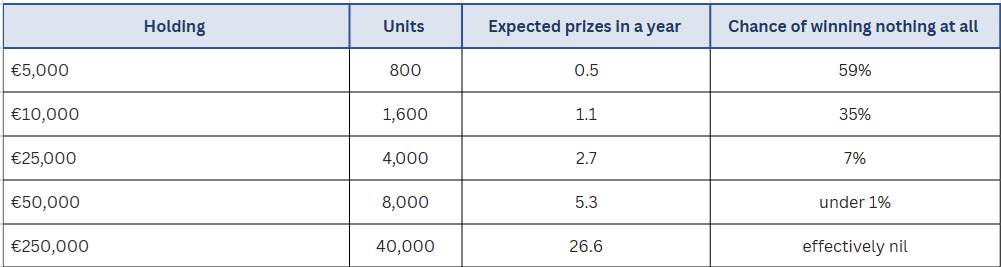
Two caveats and they matter. These are my own calculations from the published prize counts and fund size, because the NTMA does not publish odds by holding size. And they describe 2024 under the old 1.00% rate. From September the pool is 50% larger, so there will be more prizes and the odds of winning something should improve. By how much, I do not know, because the NTMA has not published how the bigger pool will be split across prize sizes, and I am not going to invent a number for it.
What the rate rise does not change is the structure. Somebody with €250,000 collects a spread of small prizes and gets something close to a reliable version of the headline rate. Somebody with €5,000 holds a lottery ticket and, more often than not, ends the year with nothing. The product is weakest for precisely the people who buy it for the excitement.
What the same State will pay you for certainty
Now the comparison that should give people pause, and it has nothing to do with banks or markets.
The 3-year Savings Bond, the 5-year Savings Certificate and the 10-year National Solidarity Bond are sold by the same organisation, on the same website, backed by the same State, with the same tax exemption. From 30 August they pay 1.96%, 2.29% and 2.66% a year respectively, tax-free, contractually, whether you are lucky or not.
Because they are tax-free, they are worth more than they look beside a bank rate. DIRT is 33%, so a tax-free rate is equivalent to a gross deposit rate of roughly one and a half times it. The Solidarity Bond's 2.66% is the equivalent of 3.97% gross, which beats anything on the Irish high street.
The honest framing of the choice is this. On one side, a certain rate for a fixed term with no access. On the other, full liquidity after 90 days, a small chance of a large prize, and a good chance of nothing. Those are genuinely different products for genuinely different jobs. What they are not is two rates you can line up and compare.
What inflation does to all of it
There is a bigger and darker menace behind every figure above, and I am not being dramatic about it.
CPI inflation in Ireland was 3.4% in the twelve months to July 2026. Even after these increases, there is nothing available in this country in net terms that keeps pace with it. Not one product.
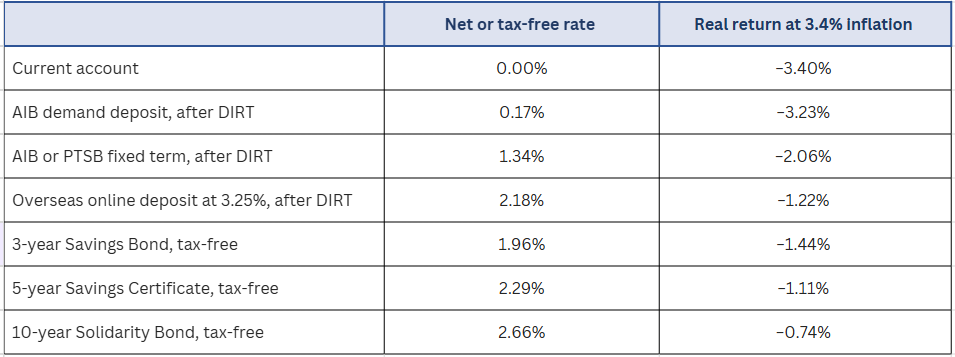
Every one of them is going backwards in purchasing power. The State Savings products are going backwards more slowly than the alternatives, which is worth something, but it is not the same as standing still. The reason a long-term diversified investment portfolio tends to feature in serious retirement planning at all is precisely this: as we have looked at in some depth on why lifestyle default strategies carry a real cost over a long retirement, holding only guaranteed, low-return cash for thirty or forty years creates its own very reliable kind of risk.
Will inflation go up, down, or stay where it is? Nobody knows. It depends on geopolitics and energy and a hundred other things well outside anyone's forecast. What we can say is what today's rate does to money left sitting still, and €100,000 left untouched for ten years at 3.4% inflation has the purchasing power of about €71,600 by the end of it.
A word of caution about the cycle
These rates are attractive right now relative to deposits. I have been in this world for over twenty years, and I am not trying to make myself sound old, but I have seen this cycle turn more than once.
You might enter the 10-year Solidarity Bond today at 2.66%, tax-free and State-guaranteed, and be delighted with it. Perfectly reasonable. But what happens if, three years from now, inflation is at 5% and bank deposits are paying 5% gross? That is not a prediction. It is a scenario I have watched play out before, and the people it happens to tend to go from "this is a great rate" to "get me out of this" fairly quickly.
Eaten bread is soon forgotten. Whatever you enter into, enter it knowing the rate is fixed for the whole term.
The guarantee with no ceiling
Two things Prize Bonds and State Savings genuinely have going for them, and both deserve full credit.
The first is the State guarantee, and it has no upper limit. Bank deposits are covered by the Deposit Guarantee Scheme up to €100,000 per depositor per institution. State Savings products sit outside that scheme entirely, because repayment is a direct and unconditional obligation of the Irish Government with no theoretical cap.
Take the fictional scenario of Máire, 64, widowed two years, with €200,000 in cash she does not need to touch. Now, Máire does not exist. I made her up. Her problem does not. To keep that money fully covered under the bank scheme she would need to split it across at least two institutions, open and manage two sets of accounts, and keep an eye on both. Or she can put it into a State Savings product and be covered in full in one place. For someone in that position that is a real structural benefit, not a marketing point. It is also worth asking, separately, what a sum like that should actually be doing within a wider retirement income plan: how much a substantial pension pot can generate in sustainable income after tax is a useful reference point for anyone managing significant cash alongside a pension.
The second is the tax exemption. No DIRT, no income tax, no CGT, no PRSI. Combined with 90-day access on Prize Bonds and no fixed term, that is a flexible place to hold money.
And then there are actual government bonds
I want to draw a firm line between two things that sound similar and are not.
A Prize Bond is not a bond. It is a prize-linked savings account with a State guarantee. An Irish government bond is a loan to the Irish State that pays a contractual coupon and has a market price.
The Irish 10-year government bond yield was around 3.36% in mid-August 2026, up about a third of a point on a year earlier. That is a better starting yield than anything on the cash shelf, and higher starting yields have historically been one of the stronger predictors of future bond returns. We looked at whether bonds still earn their place inside an ARF in a recent piece if you are weighing up how the fixed-income side of a retirement portfolio fits together.
But the wrapper decides whether that yield ever reaches you. Inside a pension or an ARF, bond returns roll up gross. Outside a pension, in a fund or ETF wrapper, exit tax applies, reduced from 41% to 38% with effect from 1 January 2026, with the eight-year deemed disposal rule still in place. A 3.36% yield inside a 38% wrapper is about 2.08% net, which is still a negative real return. Better than the cash options above. Not the free lunch the headline suggests.
Individual Irish government bonds can be a genuinely interesting option for certain individuals, and it depends heavily on the structure you use, how you access them, and the fees you pay. They belong in the defensive part of a long-term portfolio, held where the tax treatment does not eat them. They are not a substitute for money you need next year.
So should you hold Prize Bonds at all?
The question was never whether Prize Bonds are bad. It is what job this particular money is doing.
If some of it is there because the monthly draw is a bit of fun and you enjoy checking the numbers, fair play. That is a legitimate use of money and no spreadsheet overrules it. Keep a few thousand in it and enjoy it.
If a meaningful share of somebody's cash reserve is sitting there because nobody ever asked the question, that is a different situation. The rate rise has not changed the mechanism. Most holders will still receive nothing in most years, and the same State will pay a certain 1.96% for a three-year commitment that a lot of people could comfortably make.
Final thoughts
Three things worth taking away.
The rate rises are real and welcome. Everybody holding State Savings is better off than they were.
The gap between what the banks are offering and what the State is offering has got wider, and better, for new depositors in State-backed products.
And inflation remains the lurking menace behind all of it. If it holds at 3.4%, every option on this page is losing purchasing power, some faster than others.
Ultimately it is a case of asking a question most people never ask about the safest money they own: what is this actually for, and when do I need it? The rates only changed a fortnight ago, which makes this a good fortnight to look. And whatever you do, have the conversation with somebody who is on your side.
Figures quoted here reflect the NTMA announcement of 17 August 2026 and CSO data to July 2026, and are correct as at the date of writing. Rates, thresholds and tax treatment change, sometimes at short notice. Check the current position at statesavings.ie, revenue.ie or with a qualified independent advisor before acting on any of it.
I hope this helps.
Paddy Delaney QFA RPA APA
Disclaimer
The content of this site including blogs and podcasts is for information purposes only. Everybody’s financial situation is different and the content we share on our site and through podcasts may not be applicable to you.
The articles, blogs and podcasts are not investment advice. They do not take account of your individual circumstances, including your knowledge and experience and attitude to risk. Informed Decisions can’t be held responsible for the consequences if you pursue a course of action based on the information we share
Did all Ireland State Savings rates go up in August 2026?
Yes. From 30 August 2026 the 3-year Savings Bond pays 1.96% AER, the 5-year Savings Certificate 2.29%, the 6-year Instalment Savings 2.33%, the 10-year National Solidarity Bond 2.66%, and the POSB deposit account 1.25%.
You may also like...


Not sure if your pension will be enough?
Informed Decisions are one of Ireland's only remaining independent financial advice firms. Our free retirement calculator models your income, tax, and lifestyle goals — in 10 minutes.
Find out where you stand today...

.svg)