

share

Will Your Pension be enough?
Tell us about your pension, savings and lifestyle goals and we'll model your projected retirement income against what you actually want to spend. Our Retirement Readiness Scorecard will tell you where you stand in just 10 minutes. With full Irish Tax built in.
informed decisions blog
The €2m ARF Cliff: When Forced Drawdown Jumps to 6%
November 2, 2026
Do defined benefit pensions count towards the €2m ARF test in Ireland?
No. The €2m test for the 6% imputed distribution looks only at the combined value of your ARFs and vested PRSAs on 30 November. A defined benefit pension in payment or an annuity is not included, although both count towards the separate Standard Fund Threshold.
If you have €2,000 more in your ARF, and Revenue can force €40,000 more income out of it or tax you as if you had drawn it. Welcome to Ireland's €2m pension cliff you won't find on Google Maps :)
Here's the paradox, I suppose. The better your ARF does, the faster Revenue makes you draw it down. The rule behind it is the ARF imputed distribution, and once the combined value of your ARFs passes €2m, the rate Revenue applies jumps from 4% to 6% of the entire fund. An awful lot of people don't see this coming until the letter from the provider lands with an extra income bonus, as it were.
So in this piece I want to walk through the rule itself, what 6% actually looks like after tax on a large pension pot, how people end up over the line in the first place, and what you can potentially do about it.
How the ARF Imputed Distribution Works in Ireland
Right. The rule. Once you have been 60 or over for a full tax year, in practice from 61 onwards, Revenue assumes you take 4% out of your ARF every year. Whether you want it or not, and whether you draw it or not, you are taxed on it. Once you turn 70 and have been 70 for the entire year, the 4% withdrawal rate increases to 5%.
However, if the combined value of your ARFs and vested PRSAs is greater than €2m, the rate is 6%, regardless of age. And here's the bit that stings: it is 6% of the whole fund, not 6% of the bit above €2m. The entire crystallised pot. The rules are set out in Chapter 28 of Revenue's Pensions Manual.
Three more details are worth holding on to, because they come back later:
- It is measured once a year, on 30 November. That valuation date decides whether you are at 6% or not, and it is also the date your 4% or 5% is calculated on.
- What you have already drawn that year counts towards it. Actual withdrawals are deducted, and only the shortfall is treated as distributed.
- It is tested per person, not per couple. A pension is an individual account that cannot be in joint names. A pension pot you haven't started drawing from, one you haven't crystallised, isn't counted at all.
It's Revenue's way of saying, I believe: we gave you tax relief going in, and we'd like some of this tax back now. Please and thank you.
The €2m Cliff in Numbers
Take a fund sitting at €2m exactly on 30 November. At 4%, that is €80,000 treated as drawn. Now take €2,000,001. At 6%, it is €120,000. On that level of pot, a couple of thousand euro of growth means roughly €40,000 more income that you are taxed on in that particular year. That is the cliff.
If you have been 70 or over for the full year, the jump is from 5% to 6%, so the step is smaller, but it works the same way.
And look, it is a good cliff. It is a beneficial problem to have. Maybe "cliff" isn't quite the right word, but I couldn't think of a better one.
What 6% Really Looks Like After Tax
Let's take fictitious Fergal, 67. Retired engineer, married, he and his wife are both on the full State Pension and happy out. €2.1m in his ARF. I'm using the 2027 rates from the recent Budget.
At 6%, Fergal takes, or is taxed on, €126,000 from the ARF. Add two state pensions of roughly €16,000 each, assuming the maximum rate, and the household is on roughly €158,000 of gross income. Income tax comes to approximately €40,000. USC is around €6,000, and that is only on the ARF, because the State Pension doesn't carry USC. No PRSI, because they're both over 66 and drawing the State Pension. That leaves roughly €112,000 net, give or take €9,300 a month, at an effective total tax rate of about 29%.
Now put Fergal just under the line, with €1.99m in his ARF on 30 November. At 4%, the household gross is about €112,000, net is about €88,000, and the effective rate is around 21%.
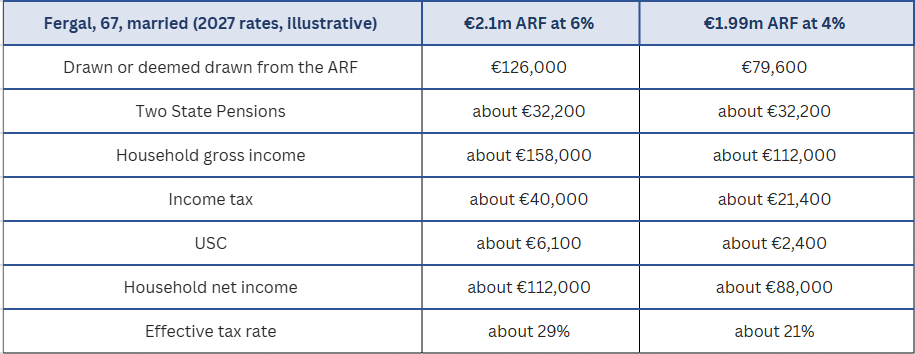
Assumptions: jointly assessed couple, both receiving the maximum State Pension (Contributory) of €309.30 a week from 2027, no other income, standard personal, PAYE, and age tax credits. Fergal is not a real client.
Those are great numbers. For the vast majority of us, €112,000 net would be a wonderful level of income, enough for an almighty life with plenty of gifting and travelling. And if €88,000 net is all they need, wonderful. If they want more, they can choose to take 6% anyway.
But the point is this: Once you cross the line, 6% is what you are taxed on, whether you need it or not. So most people draw it. Compared with 4% on the same €2.1m, the 6% pushes an extra €42,000 out of the ARF, and that is the number that really matters. At Fergal's income level, most or all of that extra €42,000 lands in the 40% income tax band and the 8% USC band. That is roughly 48% tax on money he was forced to take because of the cliff.
If you are 61 to 65, it can be more severe
Yes, I'm calling 61 to 65 younger. If you're younger, PRSI can enter the picture as well. ARF distributions can attract Class S PRSI until the relevant exemption applies, which since 2024 means until you are awarded the State Pension (Contributory) or reach 70 if you were born after 1 January 1958. On the same €2.1m, a one-income couple in their early sixties could be looking at an effective rate of roughly 35%, possibly a little more.
So the 6% itself isn't really the problem. The tax on the last euro is, if I'm explaining myself at all clearly. I always encourage people to view paying tax as a positive: it means you are doing something well. It's just that none of us want to pay more tax than we should.
Is the ARF imputed distribution taxed if I don't withdraw the money?
Yes. The ARF imputed distribution is taxed as income whether or not you take it. Anything you actually withdrew during the year is deducted first, so tax only falls on the shortfall, so on a €2.1m ARF at 6% (€126,000) with €100,000 already drawn, €26,000 is treated as distributed.
€2m in Your Pension Is Not €2m in Your ARF
The reality is, €2m in your pension is not €2m in your ARF. The 6% only bites on money that has been crystallised into an ARF or a vested PRSA, and for an awful lot of people the tax-free lump sum comes off first.
Take your 25% lump sum from a €2m pension pot, and your ARF starts at roughly €1.5m. You have taken €500,000 as cash: the first €200,000 tax-free and the remaining €300,000 taxed at 20%. Only €1.5m goes into the ARF. That is firmly in the 4% or 5% territory, a long way off the 6%.
To start retirement over the line, your ARF needs to be over €2m after the lump sum. If you have, say, €2.4m in pension pots and take a €500,000 lump sum, you start at roughly €1.9m. No 6% due on that, unless growth later drives it over €2m on 30 November. If you are weighing up the timing of that lump sum, I've worked through when to take your tax-free lump sum in a separate case study.
How People Actually End Up Over the Line
There are a handful of routes, and most of them are quiet.
Growth and contributions. Significant contributions over a lifetime, plus growth, is what has got an awful lot of people to these levels. Transfers from defined benefit schemes play a part too: years in a DB scheme, a transfer value taken out to a PRSA, then into an ARF, compounding along the way.
Growth while you draw. A €1.8m ARF, for argument's sake, growing at 6% a year net while you draw 4%, crosses €2m in about six years. That is a prudent assumption, and it creeps up on you. You're drawing 4%, the fund is at €1.8m, and then bang, you are over €2m and you go to 6%. It is one reason it is worth thinking about how long your ARF actually needs to last rather than just how big it is.
A spouse dying. Say you each have €1.2m in an ARF, both at 4%. If one of you passes away, the survivor steps into the shoes of the deceased, and that ARF becomes theirs. They now hold €2.4m, which is 6% territory: €144,000 of gross income a year. And the unfortunate thing, other than somebody passing away, is that they may or may not need that level of income. That's where it becomes a bit of a nuisance, quite frankly.
The threshold is going up. The Standard Fund Threshold rises to €2.8m by 2029. After the tax-free lump sum, the €200,000 plus another €300,000 at 20% could leave around €2.3m in a pot. The €2m trigger for 6% hasn't moved and is not indexed upwards. You could argue it should be looked at. For what Budget 2027 did change, see what actually changes for your pension and investments.
Taking less of a lump sum. Take less tax-free cash when you convert to an ARF, and you start closer to 6%, depending on where your numbers are now and where they might go.
What You Can Do About It
Right. We've boxed off the problem. Now, what can you do about it? There are four things you can do, but each comes with a catch.
First, phase your drawdown
You can potentially split a PRSA into several before you take anything. Not every scheme allows it, but a DC pension can often be moved to a PRSA, and that PRSA split before you start triggering any of them. A transfer to a PRSA usually doesn't count as vesting. You then start them one at a time, and a PRSA you haven't touched sits outside the €2m test.
The catch: every PRSA that hasn't been drawn is treated as vested on your 75th birthday at the latest. So this delays the cliff, it doesn't make it go away. Company pensions are also different. Benefits are usually taken between 60 and 70, and everything from the one employment is taken together, unless you've moved that scheme to a PRSA before the benefits become payable.
Second, two names, not one
The test is per person. €2.4m in one name forces roughly €144,000 a year at 6%. €1.2m each forces €96,000 between them at 4%. That is €48,000 a year less.
The catch, obviously, is that you can't magic up a PRSA of €1.2m for each person, and if one person already has €2.4m, you can't simply transfer it across. That's not how it works. And on the first death, as we saw, the survivor can land over the line anyway.
Third, mind 30 November
Say your ARF would be at €2.05m on the day. Untouched, that is 6%, roughly €123,000. But if you draw €80,000 earlier in the year and the value on the day is €1.97m, 4% of that is €78,800, which you have already taken.
The catch: you still had to take €80,000 out to get below the line. It's income, taxed at your marginal rate, so it is not really a tax saving. This change affects the amount that is withdrawn in a given year; individuals can make these withdrawals on their own terms, which is what some people desire. But fund values go up and down, which makes it difficult to time, and it only really helps if you are very near the line.
Fourth, start drawing earlier
This is probably my favourite. Plenty of people leave the ARF alone in the early years, or don't crystallise at all, because they don't need the money or they want to improve the probability of success. All of which I totally respect. But that is often exactly how a fund drifts over €2m, if it was anywhere near it to begin with.
If You Really Fear the Cliff
If you're in and around €2m and thinking, my God, I'm going to have to draw 6%, some would say: poor you. Also remember that a 20%, 30% or 40% market correction, which is never too far away, would solve the problem really quickly. So be careful what we wish for. Personally, I'm a fan of spending it and enjoying it, quite frankly, rather than contorting a plan around this one rule.
If you really fear it, a few honest options:
- Take a bigger lump sum. With a company pension, the 1.5 times salary route can sometimes give a bigger lump sum, but the rest then has to be taken as an annuity rather than an ARF, which turns an awful lot of people off.
- Invest more defensively. Smaller pot, smaller problem. But earning less on purpose to dodge a withdrawal rule usually costs more than the rule does, in my opinion.
- Die soon. I wouldn't recommend it. The planning is lovely, but the outcome is poor.
Three Things to Take Away
First, over €2m, the 6% applies to the whole fund, valued on 30 November, and it is tested per person. Second, the real cost isn't the 6%, it's the tax on the extra income: roughly 48% for most people at this level. Third, do the sums early: when to start each pension, in whose name, and when in the year you draw. Who knows what markets will do, but those three you can absolutely control.
Ultimately, if you're near the line, I hear you. But this is a good problem to have, as long as you plan it, it doesn't interfere with the long-term sustainability of your plan, and it still gives you choice and enjoyment. If you're within touching distance of €2m, on your own or between the two of you, it might be worth looking at before the next 30 November. Do yourself a favour and have a think about it, and have a conversation.
The figures here are based on 2027 rates and on Revenue's rules as they stand, and everyone's situation is different, so check the current position at Revenue.ie or with a qualified, independent advisor before acting on any of it.
I hope this helps.
Paddy
Disclaimer
The content of this site including blogs and podcasts is for information purposes only. Everybody’s financial situation is different and the content we share on our site and through podcasts may not be applicable to you.
The articles, blogs and podcasts are not investment advice. They do not take account of your individual circumstances, including your knowledge and experience and attitude to risk. Informed Decisions can’t be held responsible for the consequences if you pursue a course of action based on the information we share
Does the €2m imputed distribution threshold rise with the Standard Fund Threshold?
No. The Standard Fund Threshold rises in steps to €2.8m by 2029, €2.4m in 2027, but the €2m trigger for the 6% ARF imputed distribution is a separate figure and has not been increased. More people can therefore reach it after a full lump sum.
You may also like...

Not sure if your pension will be enough?
Informed Decisions are one of Ireland's only remaining independent financial advice firms. Our free retirement calculator models your income, tax, and lifestyle goals — in 10 minutes.
Find out where you stand today...

