

share

Will Your Pension be enough?
Tell us about your pension, savings and lifestyle goals and we'll model your projected retirement income against what you actually want to spend. Our Retirement Readiness Scorecard will tell you where you stand in just 10 minutes. With full Irish Tax built in.
informed decisions blog
US Estate Tax in Ireland: The $60,000 Line on US Shares
October 12, 2026

Is US estate tax due if an Irish resident dies with under $60,000 of US shares?
US estate tax is not due where a non-US person's US assets total $60,000 or less at death, and no Form 706-NA is required. The estate may still face the IRS transfer certificate process, which can take 12 to 18 months.
An American can pass on $15m of US shares before US estate tax applies. An Irish resident holding the very same shares can only pass on $60,000 before tax becomes a major threat to their plans and their legacy.
US estate tax in Ireland is something we see quite often, particularly with people working for the big US multinationals in tech and pharma who get stock as part of their compensation package, and with people who have bought shares in US companies through an investment account. The holdings build up quietly over 10 or 15 years.
An awful lot of the people I speak to know exactly how their shares are taxed when they vest, and when they sell. What very few have ever been told is what happens to those same shares if they die holding them. The answer involves a tax authority across the Atlantic which most people assume has nothing to do with them.
One thing before we start, and please bear it in mind all the way through. This is not tax advice. I am not a qualified tax advisor. What follows is my understanding, based on conversations with tax advisors and the documentation available at the time of publishing, and it is extremely nuanced. If you think this might apply to you, get actual, individual, professional tax advice.
Why Are US Shares Treated Differently When You Die?
The US charges estate tax on assets located in the US. For people who are neither US citizens nor domiciled there, the IRS is very clear: shares in a company set up under US law count as US assets, no matter where the share certificates are held. It does not matter that you might live in Kildare, Kilkenny or Killaloe, or that the shares sit on a platform based in Ireland that you log into from your kitchen table. Where the company is incorporated is what counts. The jargon for this is US situs. It is basically the US tax system's way of saying "ours".
Now, if you are a US citizen, you get an exemption of $15m in 2026 before federal estate tax applies. If you are an Irish resident with no US citizenship, the equivalent line is $60,000. Not $60 million. $60,000. The American line is 250 times higher, and unlike almost every other threshold you will come across, the IRS confirms that the $60,000 is not indexed for inflation.
Above $60,000 the rate climbs in steps, from 26% on the first slice above that line all the way to 40% on anything over $1m. The tax is charged on the total value of the US assets at the date of death, not on the gains. And the US return and the tax are due within nine months of death, in dollars. Your family does not get to wait until probate here is sorted.
What counts as a US asset, and what does not
The reality is that the test looks at the legal home of the thing you own. Shares in companies organised under US law are caught, and as I understand it the same goes for funds that are themselves domiciled in the US, none of which we recommend or use ourselves, as an aside. Shares in companies incorporated elsewhere are treated as located outside the US. That generally includes funds domiciled here in Ireland or elsewhere in Europe. They can invest in US companies all day long, but what you own is a holding in an Irish fund, so it does not fall into the US net.
What Does US Estate Tax Look Like in Actual Numbers?
Let us take the fictional scenario of Ronan McGillahoole, who is 54 and has worked for a US tech company for 16 years. Every quarter a few more shares have vested, and most of his colleagues he has held on to the majority of them. Keeping them was the easier thing to do.
Ronan coaches the under-12s, the under-14s and the under-16s at the local hurling club, and he has neither the time nor the headspace to be making decisions about his RSUs. Quite understandably, I think. He and his wife Mary sell some when the car needs replacing or the windows need doing. But there is now $750,000 of his employer's stock in that account.
Say, unfortunately, Ronan dies tomorrow, and he has left everything to Mary, as is quite typical here in Ireland. From an Irish perspective that is the simplest thing in the world. A gift or inheritance from a spouse is exempt from Capital Acquisitions Tax, which is our inheritance tax. No Irish tax payable. Job done. Happy days.
By the letter of the law in the US, it is a very different story. There is no automatic spouse exemption when the surviving spouse is not a US citizen either. There are US trust structures that can help to defer the tax, but they come with a list of conditions as long as your arm.
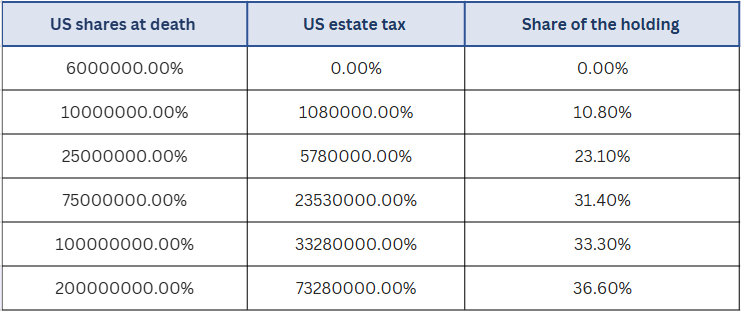
Under the US rate table, the tax on $750,000 before any credits is $248,300. Non-residents get a credit of $13,000, which is exactly the tax on the first $60,000. That is where the $60,000 line comes from. Take the $13,000 off and Ronan's family is left with a US bill of $235,300. That is roughly 31% of the value of the shares, due to the IRS on an estate where Revenue charged nothing at all. And because there is no Irish tax to set it against, it is a pure cost.
Here is the same calculation run on different holdings, using the IRS rate schedule and the $13,000 credit, before any deductions for debts or the costs of administering the estate.
Is the $60,000 US estate tax threshold per person or per couple in Ireland?
The $60,000 US estate tax threshold applies to each deceased person's own US assets. The IRS confirms that the estate of a non-US citizen not domiciled in the US cannot pass any unused exemption on to a surviving spouse.
Why Can Leaving US Shares to Your Spouse Be the Expensive Route?
Now there is a twist here, and it is counterintuitive. I hope I can explain it in some clear fashion.
Ireland and the US have an estate tax convention between them, and it dates back to 1950. Under it, Revenue's guidance says that if you inherit US property and US federal estate tax has been paid on it, you can claim a credit against your Irish inheritance tax. The credit is given at the lower of the US or the Irish effective rate, and it cannot exceed the Irish tax paid.
So for the credit to exist, there must be Irish tax to set it against. Think about what that means for Ronan. Where the shares go to Mary, there is no Irish tax, so there is nothing to write the US tax off against. The US bill is a straight loss.
If instead the shares went, for argument's sake, to his children, and the children are already over their Group A threshold for CAT, which is €420,000 for inheritances taken on or after 7 October 2026, they would be paying Irish CAT at 33% on the excess anyway. The US tax can then potentially be credited against that Irish bill.
The US tax does not disappear. Right. But in the right circumstances it can stop being an extra layer on top and become in large part tax that was going to be paid anyway, just to a different country.
Normally we would say leave it to the spouse, keep it simple. For US shares, it appears that can sometimes turn out to be the most expensive route that there is.
There are limits, and they matter. Where part of the inheritance falls inside a child's tax-free threshold, the relief is restricted and some of the US bill can remain a real extra cost. The convention covers inheritances only. It does not cover gifts, and it does not cover the death duties that individual US states may charge. And a will that sends assets past a spouse has consequences well beyond tax. If you are weighing up whether to gift now or leave an inheritance in Ireland, the US side is one more piece of that decision.
So please do not take this as a green light to start rearranging things on your own. Get Irish and US tax advice. It will cost you, but it could be a very smart investment.
What Are the Options if You Hold US Shares?
Ultimately there are two broad routes, and I believe neither is for everyone. It is a case of working out which one fits you and your family.
Reduce the US exposure
This is the most obvious one, to be fair. If the US assets are going to cause a problem on death, sell them down and reinvest in assets that are not domiciled in the US.
It sounds simple, but it is not always free. If the share price has done well, selling triggers Capital Gains Tax on the growth since vesting or purchase. The standard CGT rate is 31% for disposals made on or after 7 October 2026, down from 33%. So you are paying a tax to avoid another one.
A sense of scale helps here. Even in the extreme case where every cent of Ronan's $750,000 was gain, CGT at 31% would come to $232,500, slightly less than the $235,300 US estate tax bill. The difference is that the CGT is certain and paid now, while the estate tax only arises if you die holding the shares. And CGT on the stock dies with you, because death is not an occasion of charge to CGT.
Irish-domiciled funds come with other baggage too. There is exit tax, which is 38% for now and due to fall to 35% from 1 January 2027 under Budget 2027, subject to the Finance Bill. And there is the eight-year deemed disposal rule, which hopefully in the years to come will be a thing of the past. So potentially you are swapping one tax exposure for another, and you need to do the sums rather than follow the instinct of getting out and to hell with everything else.
There is a second benefit, and it has nothing to do with tax. An awful lot of the people we meet have their salary, their bonus and a big slice of their wealth all riding on the one company. If that company has a bad decade, is that an exposure you want to have? Will the fund you move into do better than the stock you are coming out of? Who knows. I believe we must make these decisions based on principles and on the individual's financial plan. We have written before about managing American RSUs as an Irish tax resident, including the order in which shares are treated as sold.
Keep the shares and plan around them
The second route is to hold on and plan the estate around the exposure. It probably starts with the will: who gets the US shares, can they be specified, and does it make sense to do so? The same $750,000 can cost very different amounts depending on who it is left to and what CAT those people would be paying.
It also means making sure whoever deals with your estate knows the US side exists. There is the nine-month clock and a US return, Form 706-NA, for the executor to file. The IRS also runs a transfer certificate process for the estates of non-US persons, which confirms that the US tax has been dealt with. Even where the US assets are under the threshold and no return is needed, the IRS quotes 12 to 18 months to process the paperwork for that certificate. Brilliant if your executor knows all that in advance.
Let us not let the tax tail wag the investment dog entirely here. What do you actually want to happen? Start there. But a potential haircut of this size is not to be sniffed at.
Where Should You Start?
If a big part of your wealth is sitting in RSUs or US shares, start with three checks.
- Look up where each company and fund in your account is incorporated or domiciled. Do not assume that because your broker or platform is in Ireland or Europe, the shares are too.
- Add up everything that is US-domiciled and see where you stand against the $60,000 line.
- Read your will with these particular shares in mind, and ask whether "it is all going to my spouse" has been thought through for this one asset.
If I have not made a bags of explaining all that, do yourself a favour and have a look at this aspect, whether that is with us or with another professional tax or financial planning firm. Go and have a conversation, see what your options are, and then make a decision to do something or not, as the case may be. The time to look at it is sooner rather than later.
Everything here is my understanding of the current rules, and those rules will change. Check the figures at IRS.gov and Revenue.ie, or with your own advisor, before you act.
I hope this helps.
Paddy
Disclaimer
The content of this site including blogs and podcasts is for information purposes only. Everybody’s financial situation is different and the content we share on our site and through podcasts may not be applicable to you.
The articles, blogs and podcasts are not investment advice. They do not take account of your individual circumstances, including your knowledge and experience and attitude to risk. Informed Decisions can’t be held responsible for the consequences if you pursue a course of action based on the information we share
Can executors in Ireland get more time to file a US estate tax return?
A US estate tax return on Form 706-NA is due nine months after death, and the IRS can grant up to six more months to file it. The tax itself is still due at nine months, and interest accrues on anything unpaid.
You may also like...
October 7, 2026
Budget 2027 Ireland: What Actually Changes for Your Pension and Investments
find out more
Not sure if your pension will be enough?
Informed Decisions are one of Ireland's only remaining independent financial advice firms. Our free retirement calculator models your income, tax, and lifestyle goals — in 10 minutes.
Find out where you stand today...

.svg)